Artificial intelligence has become the easiest word to say in enterprise technology, and one of the hardest things actually to deliver. A pilot project is simple. A dashboard is simple. A genuinely intelligent system that plugs into procurement, finance, logistics, and decision-makingwithout breaking, drifting, or becoming a black box — is not.
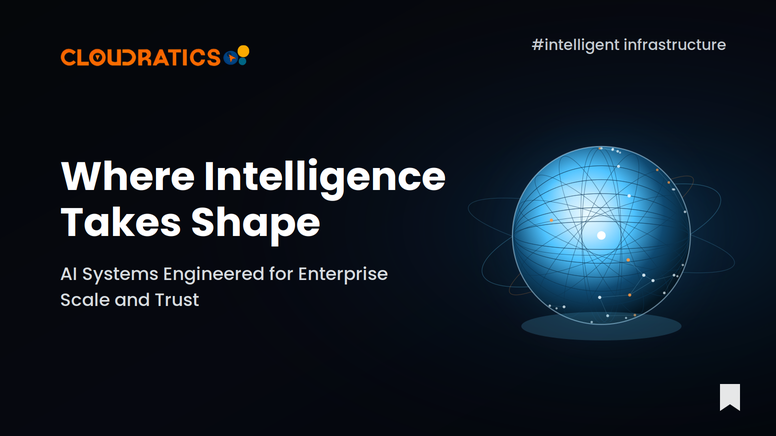
At Cloudratics, we think about AI less as a feature and more as a core: a central point of intelligence that every other system in the enterprise connects to, draws from, and feeds back into. That's the idea behind our latest campaign, Where Intelligence Takes Shape: a single glowing core, wired into everything around it, quietly doing the work of a thousand disconnected tools.
The problem with "bolted-on" AI
Most AI failures in the enterprise aren't failures of the model. They're failures of architecture. A recommendation engine that isn't connected to real-time inventory data. A forecasting tool that can't see what finance already knows. A chatbot that has no idea what your ERP system is doing three systems away.
When AI is bolted onto existing infrastructure instead of engineered into it, three things tend to happen:
- Data goes stale. Insights are only as good as the pipelines feeding them, and disconnected systems mean disconnected truths.
- Trust erodes. Once a system gives one confidently wrong answer, teams quietly stop relying on it and go back to spreadsheets.
- Scale stalls. What works for one team or one region collapses the moment it needs to run across a global operation.
None of these are AI problems. They're systems problems. And systems problems are exactly what enterprise engineering exists to solve.
Designing the core, not just the model
When we build AI systems for enterprise clients, the model itself is often the smallest part of the conversation. The real work happens around it:
Data core. Before intelligence can be useful, it needs a single, secure, well-governed source of truth — data pipelines that unify inputs from ERP, CRM, supply chain, and operational systems without duplicating or corrupting them along the way.
Cloud infrastructure. AI at enterprise scale needs to run reliably across regions, load conditions, and failure scenarios. That means infrastructure designed for elasticity and uptime from day one, not retrofitted after the first outage.
Enterprise ERP integration. Intelligence that can't talk to the systems already running the business gets ignored. Every AI system we design is built to work with existing ERP workflows procurement, finance, logistics not around them.
Governance and security. Trust isn't a UI element. It's encryption, access control, auditability, and a system that can explain itself when it's asked to.
Put together, these pieces form what we call the core: the point where data, infrastructure, and intelligence meet — engineered so that everything built on top of it can scale without cracking.
Why trust is the real differentiator
Every vendor will tell you their AI is powerful. Fewer will tell you how it fails, what it does when it's uncertain, or how a compliance team can audit its decisions six months from now. That's the gap Cloudratics builds in.
Enterprise leaders don't need AI that dazzles in a demo. They need systems that behave predictably under real conditions, integrate with the infrastructure they already have, and hold up to scrutiny from security, legal, and finance — not just innovation teams.
That's what "engineered for enterprise scale and trust" actually means in practice: not a bigger model, but a more disciplined system around it.
Where this is heading
The organizations getting the most value from AI right now aren't the ones with the flashiest models — they're the ones who treated intelligence as infrastructure from the start. A well-engineered core doesn't just answer questions. It becomes the layer every other system quietly depends on.
That's the shape intelligence is taking across the enterprises we work with: less a standalone tool, more a dependable center of gravity for how decisions get made.
Cloudratics builds that core. If your organization is trying to move past AI pilots and into AI infrastructure you can actually rely on, Let's talk.